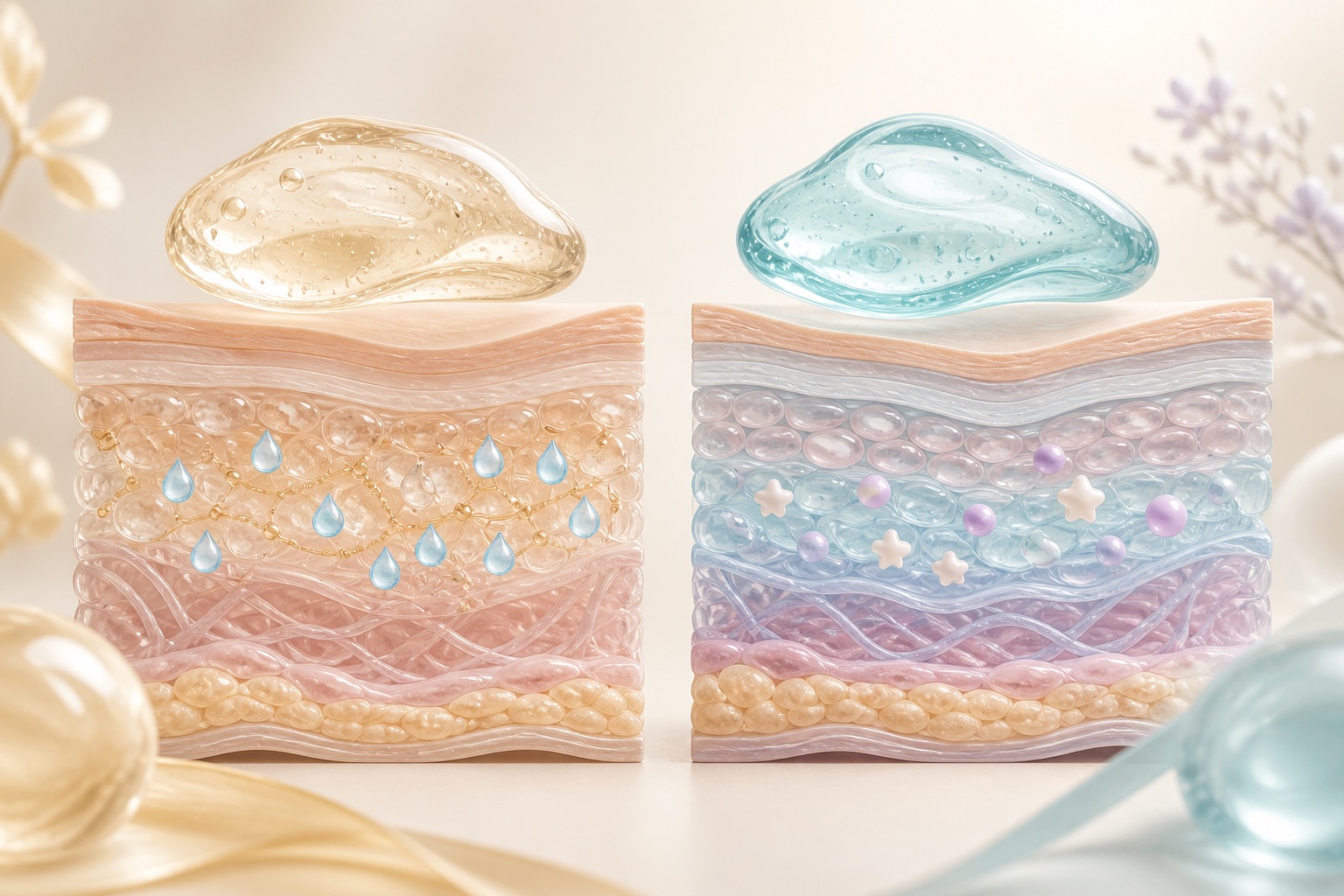
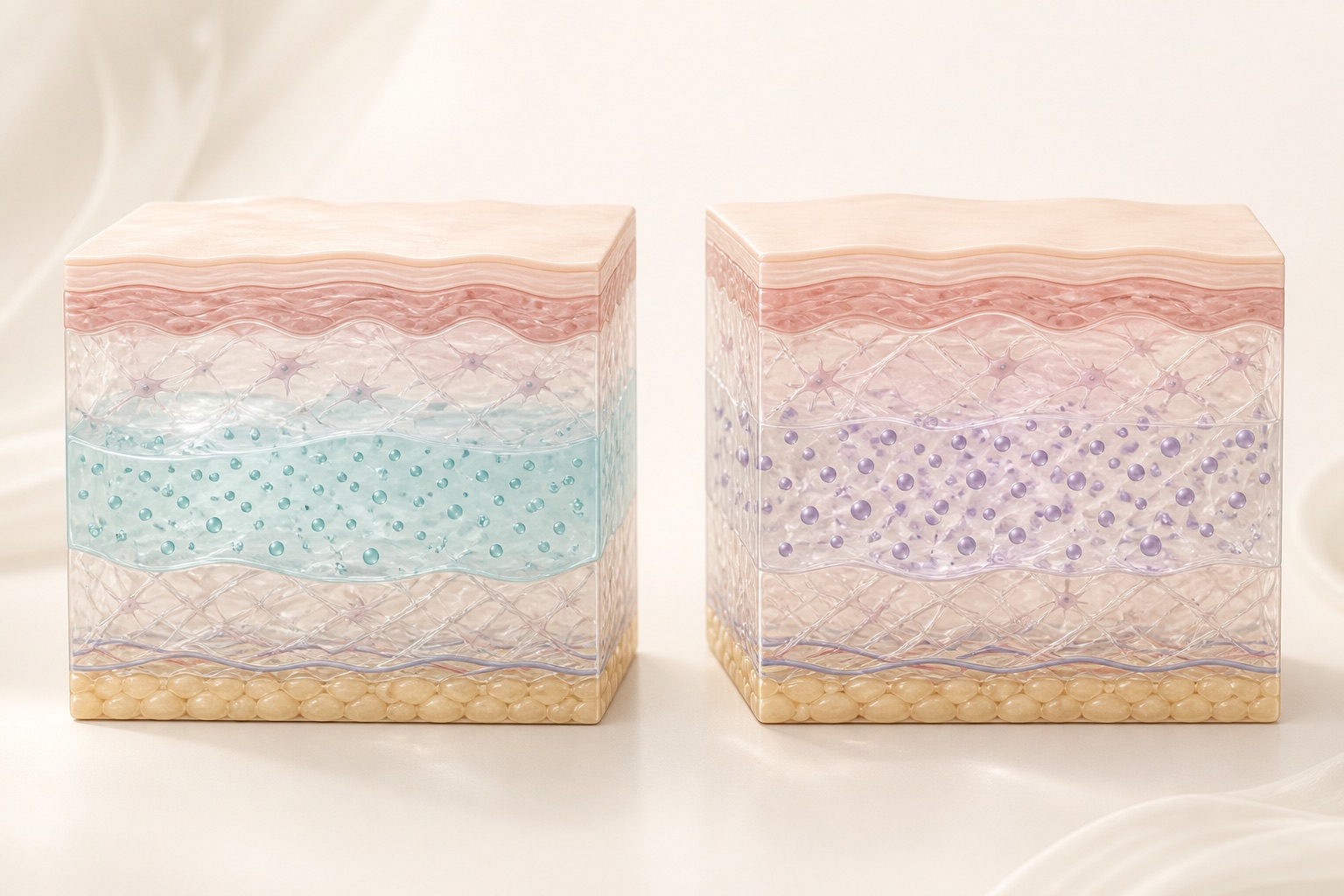
AT A GLANCE
- Radiesse
- CaHA microspheres in a gel carrier
- HA booster
- A category nickname—not one formula
- Dilution
- Changes spread and handling, not material identity
- First rule
- Choose by goal, area, local label and follow-up
The short answer: structure and hydration are not interchangeable goals
If a friend asked me whether Radiesse is simply a stronger skin booster, I would say no. Radiesse is a calcium-hydroxylapatite, or CaHA, injectable implant with microspheres suspended in a gel carrier. ‘HA skin booster’ is a broad nickname used for several hyaluronic-acid products with different concentrations, cross-linking, companion ingredients, indications and injection plans.
Radiesse may be discussed for structural support, contour or—when a clinician uses an appropriate diluted plan—broader skin-quality goals. A named HA product may instead be selected for a locally authorized fine-line, smoothness or hydration-related indication. The overlap in marketing words does not make the materials, placement or complication plans equivalent.
Le Moir lists Radiesse and several HA products, including SKINVIVE and Belotero Revive. That confirms availability, not suitability. Start by naming the concern: dry-feeling skin, fine lines, rough texture, laxity, volume loss and contour change are different clinical questions.
Why this comparison is timely in 2026
Two current trends are meeting in the same consultation. The American Society of Plastic Surgeons has highlighted rising interest in non-HA fillers and, separately, a shift from obvious volume toward overall skin quality. AAFPRS has also reported stronger demand for subtle, preservation-minded results. Those trends help explain why travelers now encounter words such as biostimulation, regeneration and injectable hydration in the same search session.
Trend language is useful for finding questions, but it is not a treatment indication. The safer move is to translate each popular term into a product name, material, authorized area, depth, amount, evidence base and follow-up plan. If those details are missing, the comparison is not ready for booking.
This guide therefore treats ‘Radiesse vs skin booster’ as a decision framework, not a winner-and-loser contest. The right answer may be Radiesse, one specific HA product, another treatment, staged care or no injection during this trip.
Radiesse: particles, carrier gel and a material-specific plan
Current US instructions describe Radiesse as synthetic CaHA particles measuring 25–45 microns suspended in a water-based carrier containing glycerin and sodium carboxymethylcellulose. In its undiluted form, the carrier contributes immediate correction while the particulate material has a different tissue interaction from a homogeneous HA gel.
Its authorized uses are country- and product-specific. Current US labeling includes moderate-to-severe facial wrinkles and folds, hand volume loss, selected jawline augmentation with Radiesse (+), and a March 2026 indication for décolleté wrinkles using Radiesse diluted 1:2 with saline in adults 22 and older. That US décolleté protocol does not automatically authorize the same ratio, area or technique in Korea.
The most useful Seoul question is not ‘Do you do hyperdilute Radiesse?’ Ask which exact product will be opened, the current Korean indication, original syringe amount, final mixture, diluent, ratio, anatomical area, tissue plane and clinical goal. A five-cc final mixture does not mean five cc of Radiesse—it includes diluent.
HA skin boosters: insist on the exact product name
Hyaluronic acid can appear in non-cross-linked solutions, lightly or more substantially cross-linked gels, and formulas that include glycerol or lidocaine. Evidence from one HA formula cannot be copied to every product sold under the skin-booster nickname, and a hydration measure is not the same endpoint as structural lift.
SKINVIVE is a useful concrete example because Le Moir lists it and owns the product photograph below. Current US directions describe a 12 mg/mL cross-linked HA gel with 0.3% lidocaine. Its US indications have included intradermal cheek smoothness and, after a 2026 supplement, horizontal neck lines. A Korean plan still needs the current Korean label and proposed area explained separately.
Before agreeing, ask to see the sealed box or syringe and record the brand, formulation, lot, expiry, total amount and treated areas. An actual product photograph helps identify a package; it does not prove that the product fits your skin concern.

Dilution changes a Radiesse plan—but does not turn CaHA into HA
Dilution changes how a particulate gel spreads, flows and contributes immediate volume. Published consensus papers discuss diluted and hyperdiluted CaHA for selected skin-laxity and skin-quality uses, but many of those techniques were off-label when published and are based partly on expert consensus rather than large, independent head-to-head trials.
The 2026 US décolleté approval is deliberately specific: one 1.5 mL Radiesse syringe is mixed 1:2 with 3.0 mL sterile saline for subdermal treatment of décolleté wrinkles. It should not be generalized into a universal facial ratio. Le Moir’s menu describes one vial mixed to 5 cc for the full face or neck, so the doctor should explain how that written menu relates to the exact Korean product instructions and your planned area.
A larger number after mixing can sound like more treatment, but final mixture volume is not a potency score. Original product amount, ratio, particle distribution, plane and area all matter. Comparing a mixed CaHA plan with a 2 cc HA plan by final cc alone would be misleading.
Reversibility: ‘HA can be dissolved’ needs an important footnote
Radiesse is not an HA gel and should not be expected to dissolve with hyaluronidase. That makes conservative product selection, anatomy, placement and an experienced complication plan especially important. Unexpected CaHA placement or nodules cannot be managed as though they were a routine HA correction.
Some HA material may be reduced with hyaluronidase, but that is not a promise of instant, complete or risk-free reversal. The outcome depends on the exact product, amount, location, timing and complication. Suspected vascular compromise is an emergency, not a cosmetic dissolve appointment, and management should follow the clinician’s diagnosis rather than online instructions.
Ask what the clinic would do for early vascular symptoms, infection, a persistent nodule, delayed inflammation or dissatisfaction—and how follow-up works after you leave Korea. A good answer should be product-specific and include an urgent contact route.
Safety and recovery: allow uncertainty in the itinerary
Bruising, redness, swelling, pain, itching, firmness, unevenness or palpable bumps can follow an injectable treatment. Less common but important problems include infection, persistent nodules, granulomatous or delayed inflammatory reactions, migration and unsatisfactory contour. Unintentional intravascular injection can cause tissue injury, visual impairment, blindness or stroke.
Current Radiesse instructions advise against use with severe allergy history, component hypersensitivity or bleeding disorders, and say active inflammation or infection should be controlled first. They also note that pregnancy and breastfeeding safety is not established, that periorbital safety is not established, and that CaHA particles are radiopaque—so future clinicians and radiologists should be told about treatment.
Seek urgent medical assessment for severe or escalating pain, blanching or dusky skin, vision change, facial weakness, trouble speaking, severe headache, trouble breathing or rapidly increasing swelling. Contact the treating clinic promptly for fever, drainage, spreading heat or redness, a firm new nodule, recurrent swelling or recovery that is worsening rather than settling.
- Name the exact product, original amount, final mixture, ratio, diluent, area and tissue plane.
- Disclose every previous filler, booster, biostimulator, thread, laser and energy treatment by date and area.
- Discuss allergy, autoimmune or granulomatous disease, infection, scarring and bleeding risk.
- Ask who injects, how vascular compromise is recognized and what emergency pathway is available.
- Keep an English treatment record and a follow-up contact that works after departure.
How I would plan this around an autumn Seoul trip
Cooler autumn weather may make heat and sun avoidance easier than peak summer, but it does not remove swelling, bruising or delayed reactions. I would not schedule a first-time CaHA or HA injectable immediately before a wedding, photo shoot, long-haul flight or tightly timed business event.
Radiesse instructions note a possible inflammatory reaction when laser, peel or another treatment based on an active dermal response is performed before tissue has healed or after the implant is placed. Do not stack an energy treatment and injectable simply because both fit into a three-day itinerary. Let the physician sequence products and areas after examining the skin.
Share arrival, important-event and departure dates before booking. Build in time for an in-person review, keep photographs of the sealed product and treatment record, and know where you would seek care at home. If the material, local indication, dilution plan or follow-up route remains vague, waiting is the sensible option.
PRICE CONTEXT · SEPTEMBER 2026
What a fair comparison includes
The closest overseas references below use one 1.5 mL Radiesse syringe. Le Moir publishes one Radiesse vial mixed to 5 cc, so its final mixture and planned area are not identical to an undiluted 1.5 mL listing. The HA row is a different product and volume. These figures are planning context—not a savings calculation.
| Market | Price | Comparison basis |
|---|---|---|
| United States · Radiesse | $800 | 1.5 mL syringe · direct Virginia plastic-surgery practice price reviewed 3 September 2026 · consultation terms differ |
| Europe · Radiesse | €450 (≈ $521) | 1.5 mL · direct Berlin dermatology price reviewed 3 September 2026 · VAT included |
| Le Moir · Radiesse | ₩700,000 (≈ $514) | 1 vial · mixed to 5 cc · full face or neck · VAT excluded · official menu dated 13 July 2026 |
| Le Moir · SKINVIVE | ₩400,000 (≈ $294) | 2 cc · full face · VAT excluded · official menu dated 13 July 2026 · different HA product and purpose |
Approximate USD conversions use ECB reference rates published 2 September 2026: €1 = $1.1578, €1 = £0.85870 and €1 = ₩1,577.57, giving a derived ₩1,363 ≈ $1; amounts are rounded and bank or card rates vary ECB reference rates.
Confirm the sealed product, original syringe or vial amount, dilution ratio and diluent, final mixture, treatment area, clinician, VAT, aftercare and written total before travel. A mixed 5 cc CaHA plan is not equivalent to 5 cc of undiluted product, and it cannot be compared with 2 cc of HA by volume alone. No cross-border savings percentage is claimed.
COMMON QUESTIONS
Before you book
Is Radiesse a skin booster or a filler?
Radiesse is a CaHA injectable implant used for product- and country-specific structural, wrinkle, contour or skin-quality plans. Calling it a skin booster does not make it equivalent to a hyaluronic-acid hydration product.
What does hyperdilute Radiesse mean?
It means Radiesse has been mixed with a clinician-selected diluent at a stated ratio to change spread and volumizing behavior. The 2026 US décolleté label uses a specific 1:2 saline protocol; that ratio should not be assumed for every country, face or body area.
Can Radiesse be dissolved like HA filler?
No. Radiesse is not hyaluronic acid and is not expected to dissolve with hyaluronidase. Some HA may be reduced with hyaluronidase, but reversal is not guaranteed to be instant, complete or complication-free.
Is Radiesse better than an HA skin booster for skin quality?
There is no universal winner. The materials, evidence, authorized areas, placement and goals differ. A physician should first decide whether the main concern is hydration, fine lines, texture, laxity, volume or contour—and whether an injectable is appropriate at all.
Can I combine Radiesse with a laser or HA booster on the same trip?
Do not assume same-day stacking is appropriate. Radiesse instructions warn about possible inflammation around treatments that provoke an active dermal response, and evidence for every product-and-area combination is not established. Let the doctor sequence the plan after examination.
How long should I stay in Seoul after treatment?
There is no universal interval. Leave room for an in-person review and plan around the exact product, area, amount, dilution, medical history and flight. Keep an English treatment record and an urgent contact route after returning home.
SOURCES & FURTHER READING
Check the original information
- Le Moir Clinic — current Radiesse treatment page
- Le Moir Clinic — current SKINVIVE treatment page
- Le Moir Clinic — official skin-booster price image dated 13 July 2026
- Merz Aesthetics — current Radiesse instructions for use
- US FDA — 2026 Radiesse 1:2 décolleté indication
- Merz Aesthetics — 2026 Radiesse décolleté instructions for use
- US FDA — dermal filler risks and limitations
- PubMed — 2026 review of hyperdilute CaHA applications and evidence
- PubMed — global consensus on diluted and hyperdiluted CaHA
- American Society of Plastic Surgeons — rising interest in non-HA fillers
- American Society of Plastic Surgeons — 2026 skin-quality trend
- AAFPRS — 2026 shift toward subtle, preservation-minded results
- Asfa Plastic Surgery — direct US Radiesse 1.5 mL price example
- Dermatologie in Berlin — direct European Radiesse 1.5 mL price example
- European Central Bank — euro reference exchange rates
Published September 3, 2026 · Last reviewed for factual accuracy September 3, 2026. Product availability, regulation and clinic pricing can change.